capability
Stephen's experience has seen him work on feature films, commercials, TV, exhibitions and a modern art installation working from Set Designer/Draftsman to Art Director.
Stephen sees his role is to facilitate the creative vision for the sets and locations that will give the unique visual identity required by finding practical solutions to creative problems. When appropriate monitor the budget and schedule, whilst overseeing other art department personnel and the Construction Department. When necessary liaise with other departments to develop solutions and to ensure the interaction required to seamlessly bring together the different elements such as visual and special effects with the sets.
Utilising an education in building construction, structural engineering, design and drafting skills along with many years of experience Stephen is able to envision conceptual ideas and designs so that they can be translated into reality by creating construction drawings that allows them to be built practically.
Careful consideration of schedule, planning, construction methods and material selection allow the designs to be realized with construction drawings in a cost conscious and timely manner.
From the smallest prop to the largest set no job is too small or too large and whatever their complexity the same care and attention to detail is always maintained. Stephen is a member of the United Scenic Artists Local USA 829. |
 |

Set layouts
One of the most important products the Art Department generates are the construction drawings as they communicate the set designs into buildable forms allowing the vision to become reality. Working as a set designer much experience has been gained drawing set construction drawings from classical architecture to futuristic spacecraft, by hand and by utilising CAD. Care is always taken to ensure that the set layout drawings are produced to define the overall look, space and volume of the set and reference the details and components that will make up the set. The methods of construction, materials, cost, schedule and shooting requirements are always considered as the set drawings are developed. |
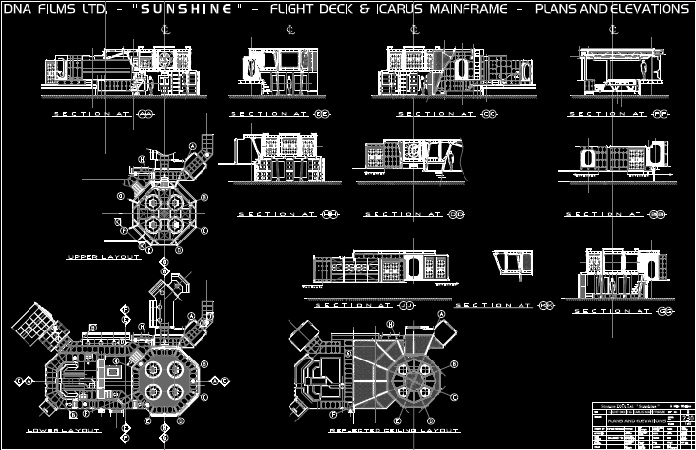 SUNSHINE - Int. Flight Deck - Plans Elevations |
Set Details
To ensure the set has the necessary detail to make it believable and so it also fulfils the shooting requirements the set detail drawings are produced to show portions of the set to ensure that the detail is communicated fully. |
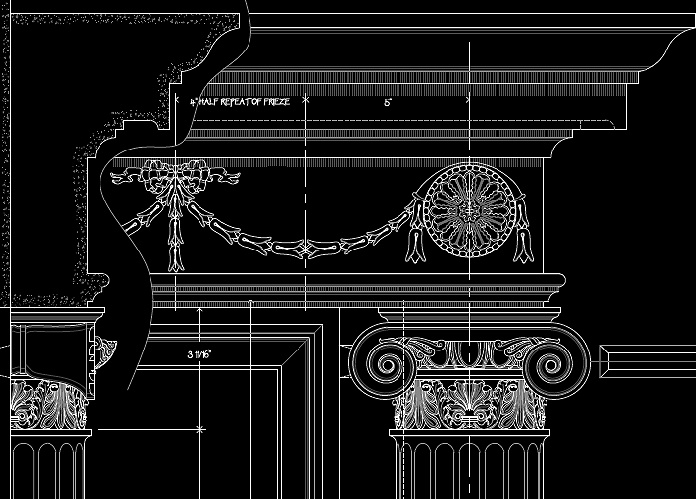 BATMAN BEGINS - Ext. Narrows - Ionic Column Detail |
Miniatures
By co-ordinating with the model makers, construction drawings are developed which are sympathetic to the modelling methods and still maintain the necessary detail for shooting. The Petronas Twin Towers in Kuala Lumpur were featured in Entrapment. To generate the exterior backdrops to the live action a 30 foot high tenth scale replica was created of fifty floors of the two towers and also of the sky bridge that connects them. The huge quantity of parts and the overall size required that the construction had to be as simple as possible and yet still have adequate detail to mimic the originals. Careful consideration was given to how to construct the model and by drawing the construction drawings in CAD it was also possible to generate individual part drawings that could be CNC cut or etched from brass to greatly speeding up the model build and ensuring accuracy. |
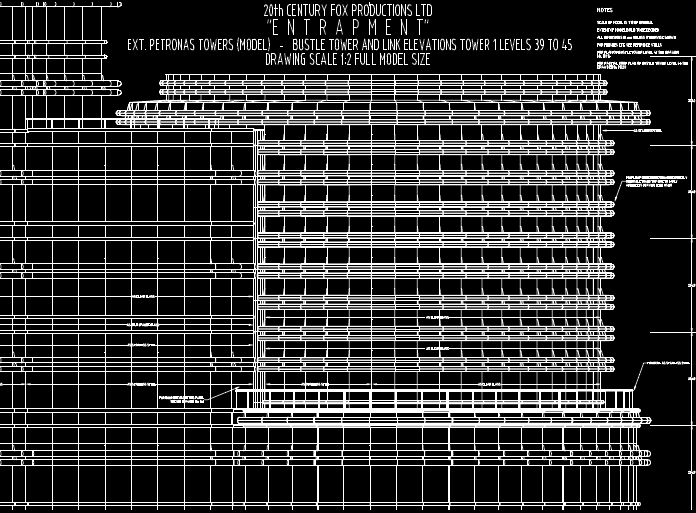 ENTRAPMENT - Ext. Petronas Towers Model - Bustle Tower |
SFX Rig Design
Utilising structural engineering skills and knowledge Stephen is able to design SFX rigs. Often elements of a set or sometimes the whole set require supporting steelwork to hold them on the SFX rig or the SFX rig within the set. Working with the Special Effects technicians their requirements can be worked into the set drawings. The swinging staircase in the Harry Potter movies relies on a circular slew ring built into the landing which is square. The landing itself was not to rotate so over-lapping plates were design to maintain the square landing so the artists could safely walk over the landing whilst the staircase turned. The whole mechanism was designed to fit within the 8" thickness of the landing and to support the weight of the staircase with the artists aboard. |
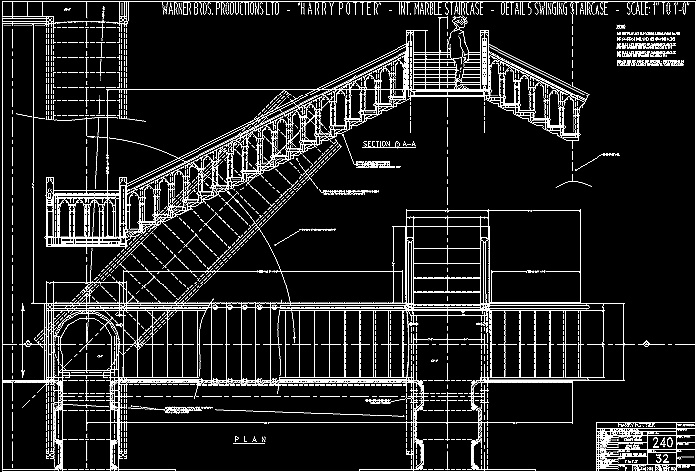 HARRY POTTER - Int. Marble Staircase - Swinging Staircase |
Set Dressing pieces
Much experience has been gained with the design and drawing of set dressing pieces. With the ability to work out how the piece can be made and then break it down into component parts that can then allow their fabrication either by hand or CNC machining and cutting. |
|
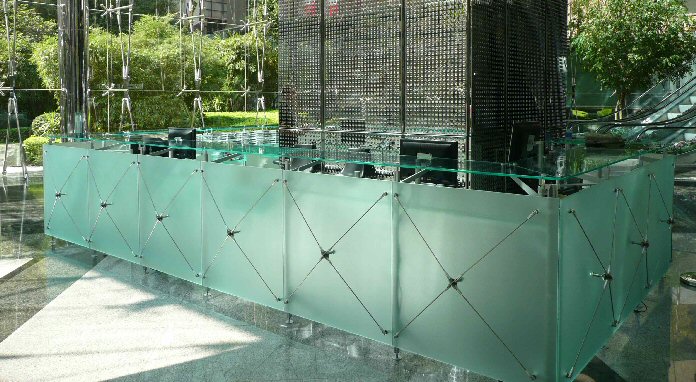
technical dressing
Often the set dressing is contiguous with the set itself and therefore the design of the two go hand-in-hand. This is especially true for technical dressing such as consoles which have featured on a regular basis in the projects and sets worked on. |
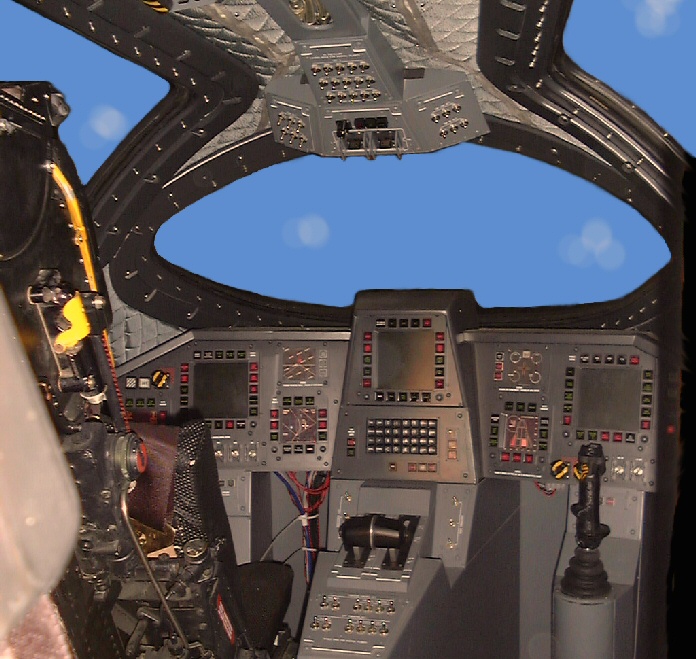
Action Props and hand props
Stephen is able to combine his understanding of how things can be made along with CAD skills to enable the design and drawing of props so that they and/or their components that go to make them can be made directly from the CAD drawings such as CNC laser, router and water cutting, transfer/rubdown printing, graphics, engraving, etching and rapid prototyping from 3D CAD models. |
|
The Alethieometer case for 'The Golden Compass' was concepted to be covered in engraving which consisted of lettering and symbols. The prop maker James Enright was quoted by an engraver who required 12 weeks to carry out the work! This time was totally unacceptable and so James asked if a 3D model could be produced which then could be rapid prototyped. A 3D AutoCAD solid model was created which included the base, lid, hinge, detailing and all the engraving in two weeks. As James had other brass props and dressing to make he set up a foundary within the studios. The rapid prototyping of the Alethiometer took just two days to be completed and from the resin model silicon rubber moulds were taken. The wax castings could then be moulded and these were then covered in silica slurry which was built up to form a silica mould. This mould was baked to cure it and to release the wax leaving a silica mould capable of casting molten brass. |
THE GOLDEN COMPASS - Alethiometer 3D Model |
To ensure the lid and base were tight fitting additional material was added to the CAD model around the joint of the two halves so they could be turned in a lathe to be exact and also the interior of the base could be bored out to be able to accept the interior workings and details which included various pieces that were drawn in CAD so they could be etched from brass including the compass needles and cog workings.
|
THE GOLDEN COMPASS - Alethiometer Internal Etchings |
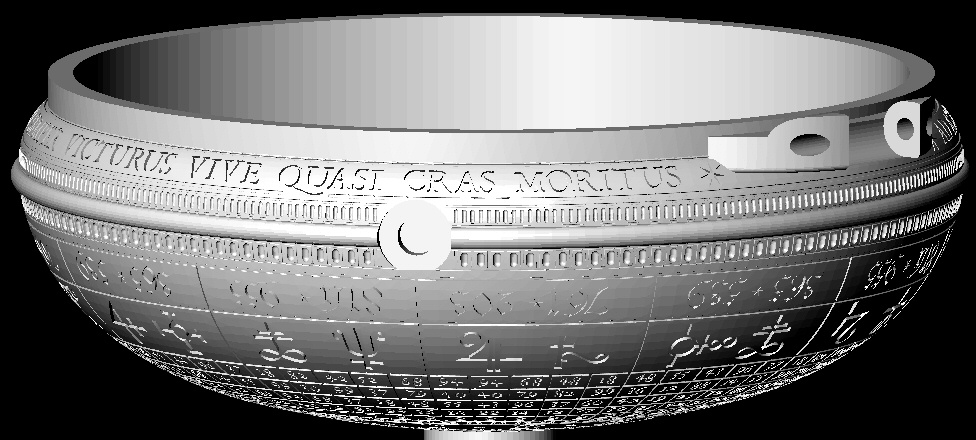


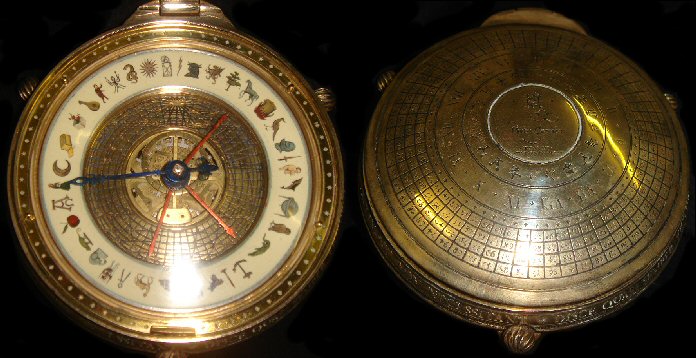
THE GOLDEN COMPASS - Alethiometer
One of the weapons from DOOM is a vicious looking chainsaw. The blade was formed from layering different thicknesses of aluminum that was CNC cut directly from CAD drawings to ensure each piece perfectly fitted. |
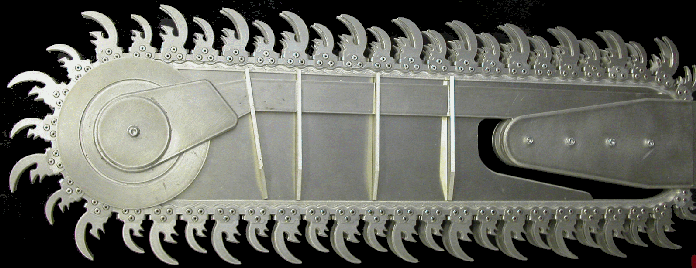 DOOM - Chainsaw Blade |
Vehicles and vessels
Stephen has gained much experience drawing vehicles of all types. The very first film worked on envolved drawing and overseeing the builds of the flying taxi and police cars in THE FIFTH ELEMENT. Other projects have included a Hong Kong Tram and Aircraft for TOMB RAIDER II, the Monorail train for BATMAN BEGINS, London Underground train interior for a MALTESERSs commercial, submarine for a COCA-COLA Commercial, Nieuport 17 Bi-Plane for FLYBOYS and spacecraft for THUNDERBIRDS. |
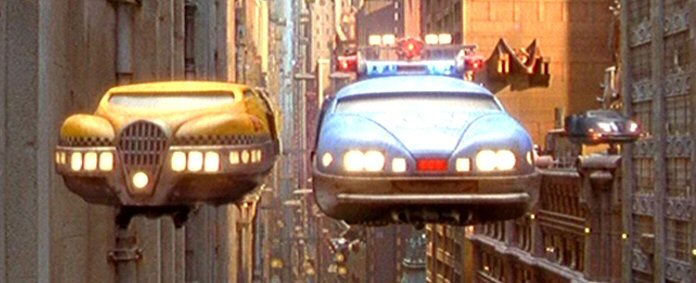 THE FIFTH ELEMENT - Taxi and Police Cars | =
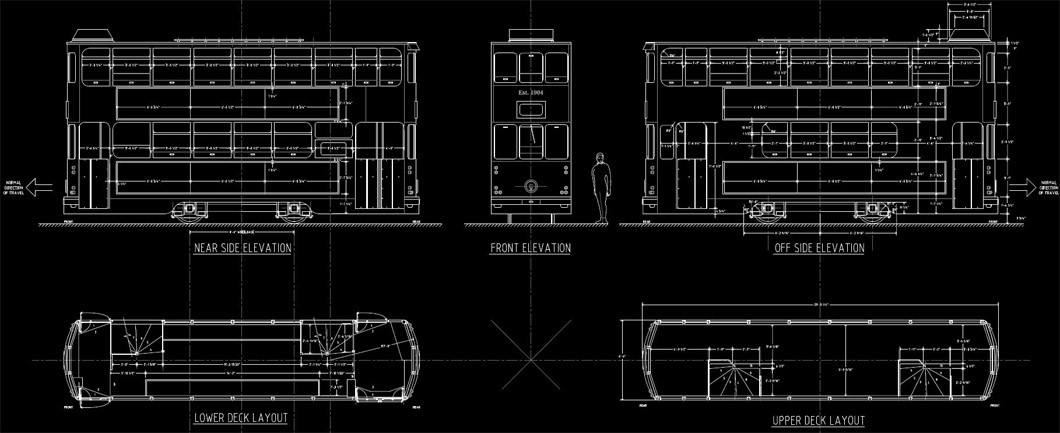
TOMB RAIDER II - Hong Kong Tram
Exhibitions
Stephen's skills have been called upon for use on other projects such as modern art installations and exhibitions. Stephen was responsible for two rooms within THE BODY ZONE at the Millennium Dome which was built in Greenwich, London to celebrate the new Millennium. The Body Zone consisted of a huge half male half female reclining figure designed by Branson Coates Architects. Within the body were various rooms the public could walk through. The laboratory room involved a member of the public being selected, scanned, the image of their forehead appearing on the over-head screen which then zoomed in to reveal bugs crawling around the skin! Great care and attention had to be paid to not only the functionality but also the health and safety of a very heavily trafficked public space. |
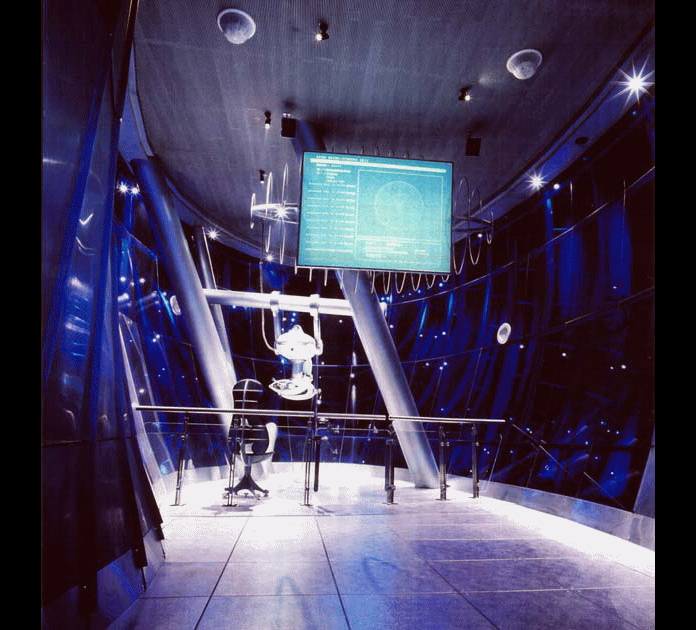 THE BODY ZONE - MILLENIUM DOME - Lab Room |
Art Installations
Artist Dominique Gonzalez-Foerster vision for the 'TH-2058' art installation within the cavernous Turbine Hall of the Tate Modern in London included enlarged re-productions of large modern art sculptures. Two of the original sculptures were fabricated from steel. The Maman utilised steel tubes welded together to mimic the sinew of a spider's legs and the Flamingo piece was formed from steel plates. As the TH-2058 exhibit was to be inplace for only 6 months the replicas had to be constructed in alternative lightweight materials. The Maman legs were made from polystyrene clad over a lightweight steel box frames and the Flamingo was constructed from 20mm thick corrugated cardboard covered in a fibre-glass skin. The arches for the Flamingo were CNC cut with jigsaw like joints to ensure the correct profile and steel plates with holes for bolting were embedded in the ends of each section and in the centre piece to give additional strength and ease of assembly on-site. |
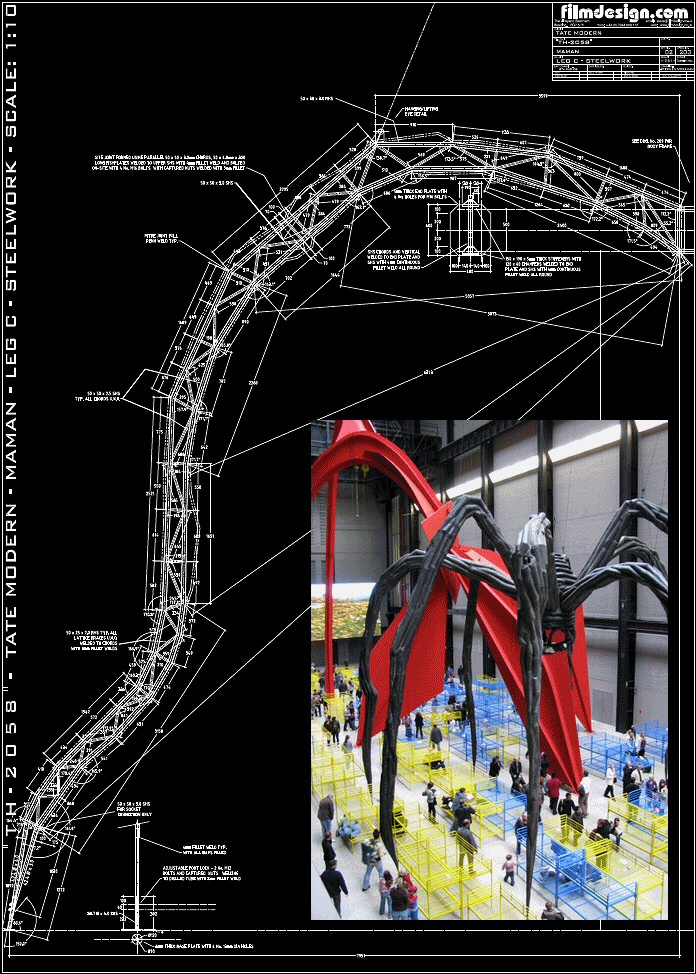 Tate Modern - TH 2058 - Maman and Flamingo Reproductions |
Computer aided design
The ability to draft by hand and also by using computer aided design (CAD) allows the benefits of the two techniques to be maximised and sometimes combined. Both techniques have their advantages when compared to each other. The ability to sketch, rough-out designs and create free flowing lines is easier by hand but CAD allows complex geometry to be constructed and defined with arc centres remote to the drawing sheet. CAD gives the ability to modify drawings with minor effort making corrections and adjustments far quicker than they would be by hand.
As it is usual practice to draw 1:1 in CAD and then scale the drawing when ploting, the set layout can quickly by used to create the detail drawings. Accurately drawn CAD components can be extracted from the set drawings and used to cut on Computer Numerically Controlled (CNC) machines using the drawing directly saving the cost of the CNC company re-drawing from a hand drawn drawing, ensuring the items are as intended and that they will fit.
CAD drawing files can be easily emailed anywhere in the world allowing remote working, sending drawings for CNC cutting, drawing approval and the CAD drawings can be amended locally to suit a location.
CAD drawing also gives the ability to draw in three dimensions. This can be useful when designing a complex set and now with 3D printing and rapid prototyping machines the ability exists to have components, props and models made directly from the 3D drawing. Once a set has been drawn in 3D a multitude of views can be created and walkthroughs made.
Once sets have been drawn in CAD they can be used directly by Visual Effects to develop CG elements saving time not havingt to re-draw from hand drawn drawings. CAD will give better control to the Art Dept. of the inter-action between the live sets and the computer generated world.
Structures
Frequently the knowledge and experience of structural engineering has been utilised to design supporting frames for sets which were either hidden from view or they formed an integral part of the seen set. This skill allows the design of the sets taking into consideration strength and often the visual design and strength are so intertwined that it would be difficult to of had the two carried out by different people. The Thunderbird 1 set for 'Thunderbirds' was formed from rolled steel box section, clad in a fibreglass skin with an internal steel spine and CNC laser cut steel profiles to form the window frames. The whole set was then mounted on a SFX rig or it could be positioned in any attitude on stage. The swinging staircase in the Harry Potter films where the staircase was made to turn practically had to have a steel frame hidden within the stair flight and landing which also included a slew ring. The stair flight was supported by steel trusses within the handrail, balusters and treads as the 'stone' treads were not thick enough to have accommodated enough steel alone. The steel tube within Harry Potter's broomstick was designed to minimise weight but also ensure its strength to carry the weight of the artists as the broom stick was attached to a SFX rig away from the broomstick. |
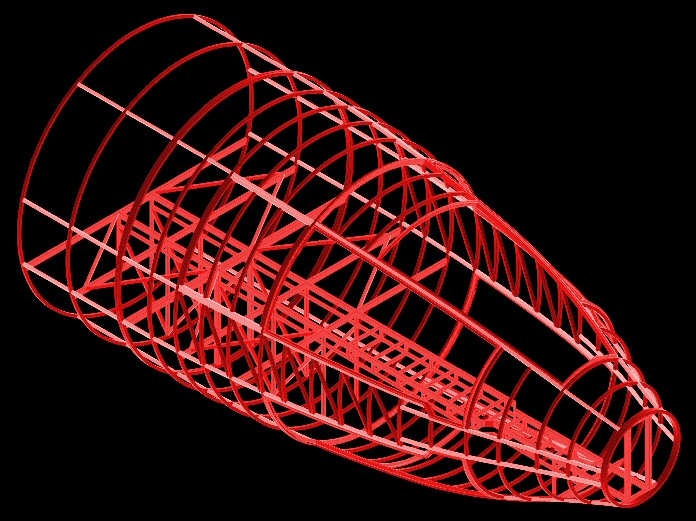 THUNDERBIRDS - Thunderbird 1 Steelwork |
The huge Interior Ice Palace set for 'Die Another Day' required extensive steelwork to support the 'ice' buttresses and floors. The floors were designed to carry the stunt vehicles so the car chase could be filmed within the set. The drawing shown below shows some of the steelwork supporting the curved balconies over the bar area and included a removable section which was re-dressed with a break-away piece for the villain's car to crash through. 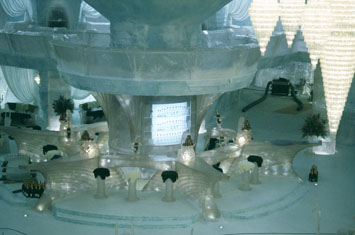 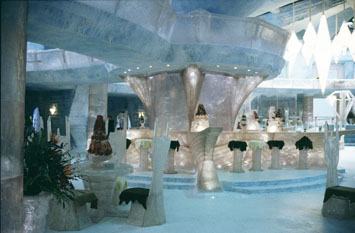 DIE ANOTHER DAY - Int. Ice Palace |
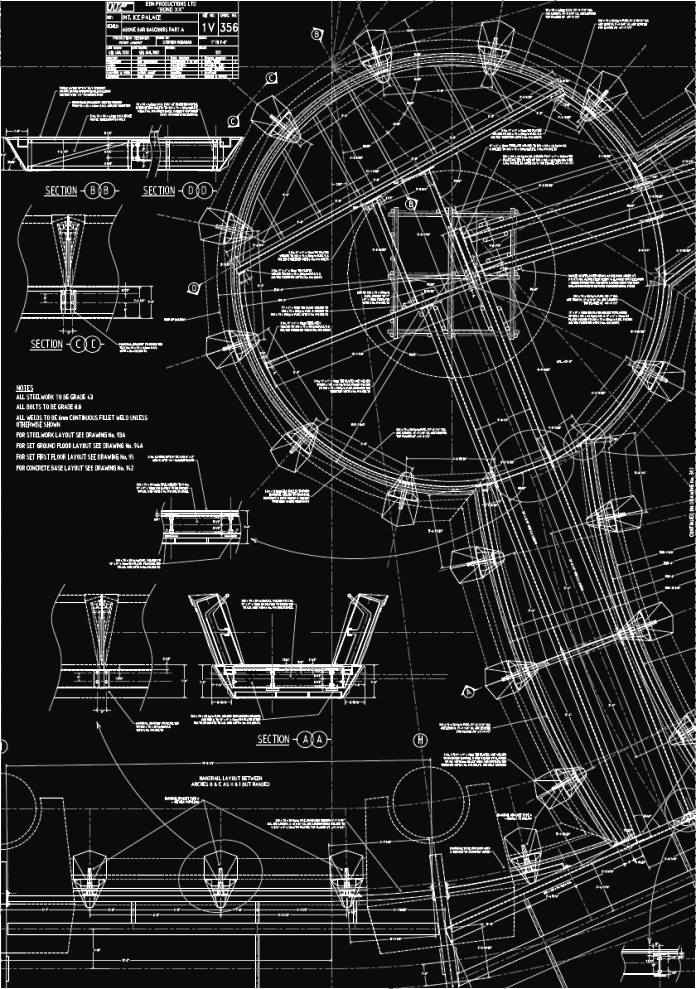 DIE ANOTHER DAY - Int. Ice Palace - Steelwork Over Bar Area |